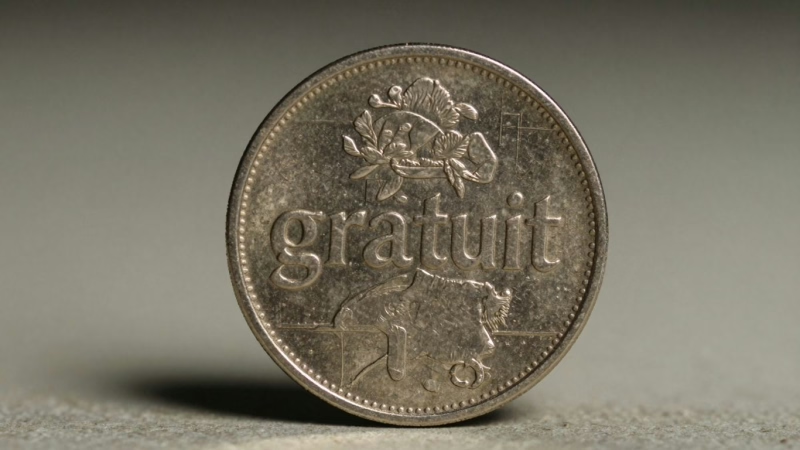
Understanding 'Gratuit': More Than Just Free in French
So, we're talking about the French word 'gratuit' today. You might think it just means 'free,' like when something costs no money. But honestly, it's a bit more complicated than that. Sometimes 'gratuit' can hint at something else going on, or maybe it's just used in specific ways that aren't about paying. Let's break it down a little, shall we?
Key Takeaways
-
'Gratuit' primarily means 'free of charge' or 'complimentary,' like a free sample or free entry.
-
It's important to distinguish 'gratuit' from 'libre.' While both can translate to 'free,' 'libre' often refers to freedom, availability, or being unoccupied.
-
The phrase 'Si c'est gratuit, vous êtes le produit' (If it's free, you are the product) highlights that sometimes 'free' services mean your data or attention is being sold.
-
'Gratuit' can also describe actions that are unwarranted or done without reason, like an 'accusation gratuite' (groundless accusation).
-
Related terms include 'gratuitement' (the adverb for 'free of charge') and the informal 'gratis' or slang 'gratos'.
Understanding Gratuit: Beyond Simple 'Free'
When you first hear the French word 'gratuit', your mind probably jumps straight to 'free'. And yeah, that's often the main idea. But like a lot of words, especially in French, it's got a bit more going on than just that. It's not always as straightforward as getting something without paying.
The Core Meaning of Gratuit
At its heart, 'gratuit' means something is offered without cost. Think of a free sample at the grocery store or a free phone number you can call. It's about the absence of a monetary price. It describes something you don't have to pay for. This is the most common way you'll see it used, and it's pretty simple.
Grammatical Forms of Gratuit
'Gratuit' is an adjective, and like many French adjectives, it changes its ending depending on what noun it's describing. So, you'll see it in a few different forms:
-
Gratuit: Used for masculine singular nouns (e.g., un service gratuit - a free service).
-
Gratuite: Used for feminine singular nouns (e.g., une entrée gratuite - free entry).
-
Gratuits: Used for masculine plural nouns (e.g., des billets gratuits - free tickets).
-
Gratuites: Used for feminine plural nouns (e.g., des places gratuites - free seats).
It's just a matter of making the word agree with the noun, which is pretty standard in French grammar.
Distinguishing Gratuit from Libre
This is where things can get a little tricky. The other French word that often gets translated as 'free' is 'libre'. While 'gratuit' is about not costing money, 'libre' is more about freedom, availability, or being unrestricted. For example, 'une place libre' means an available or empty seat, not a seat that costs nothing. And 'un esprit libre' is a free spirit, someone unburdened by convention. So, while both can mean 'free', they point to different kinds of freedom.
Sometimes, when something is offered for free, it's not really free at all. You might be paying with your data, your attention, or by becoming the product yourself. It's a good idea to keep that in mind.
Common Phrases Featuring Gratuit
You'll run into 'gratuit' in a bunch of everyday French phrases, and understanding them can really help you get around. It's not just about things costing zero dollars; it often points to specific situations or types of services.
Complimentary Services and Goods
This is probably the most common way you'll see 'gratuit' used. Think about when you get something extra with a purchase, or when a service is offered without charge. It's that "on the house" feeling.
-
Appel gratuit: This means a "freephone" number, like those customer service lines you can call without using up your minutes. You might see this advertised for companies wanting you to reach them easily.
-
Entrée gratuite: "Free entry" or "free admission." This is common for events, museums on certain days, or parties where there's no ticket price.
-
À titre gratuit: This is a more formal way of saying "free of charge" or "gratuitously." You might see this in official documents or when something is given as a gift or donation.
Actions Without Justification
Sometimes, 'gratuit' describes an action that seems to have no real reason or motive behind it. It's like something done on a whim, or perhaps unfairly.
-
Acte gratuit: This refers to an "action without motive or reason." It's something done for no particular purpose, which can sometimes be seen as a bit odd or even pointless.
-
Accusation gratuite: This translates to an "unwarranted" or "groundless accusation." It means someone is being accused of something without any evidence or good reason, which is never a nice situation to be in.
When something is described as 'gratuit' in this sense, it often carries a negative connotation, implying a lack of sense or fairness. It's not just about the absence of cost, but the absence of a valid cause.
Legal and Formal Contexts
In more official settings, 'gratuit' can appear in specific legal or business terms. It usually sticks to the 'no cost' meaning, but the phrasing can be a bit more technical.
Here's a quick look at how it might appear:
Phrase | English Translation |
|---|---|
Service gratuit | Free service |
Offre gratuite | Free offer |
Consultation gratuite | Free consultation |
Échantillon gratuit | Free sample |
These phrases are straightforward and clearly indicate that no payment is expected. If you're planning a trip to France, knowing phrases like bonjour and merci is a good start, but understanding these 'gratuit' terms will help you spot deals and understand offers better.
The Nuance of 'Gratuit' in Context

Sometimes, 'gratuit' isn't just about getting something for nothing. It can carry a bit more weight, hinting at things that aren't quite as straightforward as they first appear. The real trick is understanding what's implied when something is offered as 'gratuit'.
When 'Free' Implies a Catch
We've all seen those "free trial" offers, right? They sound great, but often there's a hidden catch. In French, 'gratuit' can sometimes be used in situations where the 'free' aspect comes with strings attached. Think about a free phone line that has incredibly long wait times, or a free sample that requires you to sit through a lengthy sales pitch. The item or service itself might not cost money upfront, but your time, attention, or personal data might be the actual price.
The User as the Product
This is a big one, especially in the digital age. You know the saying, "If you're not paying for the product, then you are the product." This idea is often linked to 'gratuit' in French. When a service like a social media platform or a free app is offered, and there's no direct charge, it's common for the company to make money by collecting and using your data. Your online activity, your preferences, even your personal information – that's what's being sold to advertisers. So, while the app was 'gratuit', your engagement and data are what's truly valuable to the provider.
It's a modern twist on an old idea: nothing is truly free. There's always a cost, even if it's not measured in dollars and cents. Understanding this helps you look beyond the initial offer and see the bigger picture.
Idiomatic Expressions and Their Meanings
French, like any language, has its own ways of using 'gratuit' that might not be immediately obvious. For instance, an 'accusation gratuite' isn't just a free accusation; it means an accusation that's completely unfounded or baseless. Similarly, an 'acte gratuit' is an action done without any particular motive or reason, sometimes even a spontaneous or impulsive one. These phrases show how 'gratuit' can extend beyond just a lack of monetary cost to imply a lack of justification or purpose.
Here are a few examples:
-
Appel gratuit: A freephone number, usually toll-free.
-
Entrée gratuite: Free admission to an event or venue.
-
Accusation gratuite: An accusation made without any evidence or reason.
-
Acte gratuit: An action performed for no specific reason.
Exploring Related Terms
While 'gratuit' is the star of our show, French offers a few other words and phrases that play in the same sandbox, sometimes with subtle differences. It's good to know these so you don't get them mixed up.
Gratuitement: The Formal Adverb
Think of 'gratuitement' as the adverbial form of 'gratuit'. It means "without charge" or "for free" and is often used in more formal or official contexts. You'll see it in written agreements, official notices, or when describing a service that is officially offered at no cost.
-
The service is provided gratuitement (free of charge).
-
The company offered a gratuitement consultation.
-
Entry to the museum is gratuitement on Tuesdays.
Gratis: Informal Usage
'Gratis' is a Latin word that has made its way into French, and it's generally more casual than 'gratuit'. It's often used in everyday conversation to mean "free of charge," but it can sometimes carry a slightly less official feel. It's like saying "on the house" or "freebie."
Sometimes, something offered 'gratis' might still have a hidden cost, like your time or attention. It's not always a straightforward "no strings attached" situation.
Grats: Slang Variations
This is where things get really informal. 'Grats' is slang, often used in online gaming communities or among younger people. It's a shortened, punchy way to say "congratulations" or "thanks," but it can also sometimes refer to something received for free, especially in a gaming context (like in-game items).
Here's a quick look at how these terms might appear:
Term | Formality | Common Usage |
|---|---|---|
Gratuitement | Formal | Official statements, written agreements |
Gratis | Informal | Everyday conversation, casual offers |
Grats | Slang | Online gaming, informal congratulations/thanks |
Knowing these variations helps you understand the full spectrum of how "free" is expressed in French, from official pronouncements to quick online chats.
Gratuit in Everyday Scenarios
You see 'gratuit' pop up all over the place in daily life, and it's not always as straightforward as just 'free'. Sometimes, what seems like a gift comes with strings attached, or maybe the 'free' thing is just a way to get you to pay in a different way.
Free Entry and Phone Lines
Think about events or services that advertise "entrée gratuite" (free entry) or "appel gratuit" (free phone line). These are pretty common. You might get into a museum without paying an entrance fee, or call a customer service number without it costing you anything from your phone bill. It's a straightforward use of the word, meaning no direct monetary cost to you at that moment.
However, even here, there can be a catch. Free entry might mean you're expected to buy something inside, or the "free" phone line might have long wait times, costing you your own time. It's a good reminder that 'gratuit' doesn't always mean zero cost overall.
Unwarranted Actions and Accusations
Beyond just things you get for free, 'gratuit' also describes actions or statements that are baseless or without good reason. You might hear about an "accusation gratuite" – an accusation that's thrown around without any proof or justification. It's like someone saying something mean just for the sake of it, with no real point.
This usage highlights a different side of 'gratuit': something done without a valid motive or cause. It's not about cost, but about lack of reason. It can feel unfair when someone makes an "acte gratuit" – a random act that seems to serve no purpose, or an "accusation gratuite" that feels like it came out of nowhere.
The Concept of 'Free of Charge'
When you see "à titre gratuit," it's a more formal way of saying something is provided free of charge. This is often used in legal or official contexts. It's the proper way to state that no payment is expected.
The idea that if something is free, you might be the product is a modern twist on the old concept. It means that instead of paying with money, you might be paying with your data, your attention, or by being exposed to advertising. It's a trade-off that's become very common in the digital age.
Here's a quick look at how 'gratuit' appears in these contexts:
French Term | English Translation |
|---|---|
Entrée gratuite | Free entry |
Appel gratuit | Free phone call |
À titre gratuit | Free of charge |
Accusation gratuite | Unwarranted accusation |
Acte gratuit | Action without motive |
Wrapping It Up
So, there you have it. While 'gratuit' might seem like a simple translation for 'free' in English, it's got its own nuances. It's not just about getting something without paying; it's about that specific kind of 'no cost' situation. Remember, when you see 'gratuit' or its variations, think 'complimentary' or 'on the house.' It’s a small word, but knowing the difference between this and other ways to say 'free' in French, like 'libre,' can really help you avoid confusion and understand things a bit better. Keep an eye out for it, and you'll start noticing it everywhere!
Frequently Asked Questions
What's the main difference between 'gratuit' and 'libre' in French?
'Gratuit' means something costs nothing, like a free sample. 'Libre' means something is available or not busy, like an open parking spot or a free spirit. So, while both can mean 'free,' they talk about different kinds of freedom.
Are there different ways to say 'gratuit' in French?
Yes! 'Gratuit' is an adjective, so it changes its ending to match the word it describes. You might see 'gratuite' (for feminine words), 'gratuits' (for masculine plural words), or 'gratuites' (for feminine plural words). There's also 'gratuitement,' which is an adverb meaning 'for free.'
What does the phrase 'Si c'est gratuit, vous êtes le produit' mean?
This popular saying translates to 'If it's free, you are the product.' It's a warning that if you get something for no cost, like a social media app, the company might be making money by using your personal information or by showing you lots of ads.
Can 'gratuit' mean something other than 'free of charge'?
Sometimes, yes. 'Gratuit' can describe actions or words that are done without a good reason or justification, like an 'accusation gratuite' (an unwarranted accusation). It suggests something is done for no purpose or motive.
What are some common French phrases that use 'gratuit'?
You'll often see 'appel gratuit' (freephone number), 'entrée gratuite' (free entry), and 'à titre gratuit' (free of charge). These phrases show how 'gratuit' is used for things that don't cost money.
Is 'gratis' the same as 'gratuit'?
'Gratis' is a more casual, informal way to say 'free,' often used in everyday talk. 'Gratuitement' is the proper adverb for 'free of charge,' while 'gratuit' is the adjective. You might also hear 'gratos,' which is slang for free.